"Here is a tidbit of news. Sunday afternoon [LSU's] President Smith took me for an automobile ride and asked if a literary quarterly could be edited here if he could get the jack in large quantities. I was not coy....The magazine will be called the Southern Review." ŻŻRobert Penn Warren to Allen Tate March 20, 1935
"Cross your fingers and pray that Louisiana doesn't go broke!" ŻŻWarren to Frank Owsley March 21, 1935
|
Selected Letters of Robert Penn Warren Volume Two THE SOUTHERN REVIEW YEARS 1935-1942 EDITED, WITH AN INTRODUCTION, BY
Louisiana State University Press, 2001
ClickŻŻ For a review of Clark's Selected Letters of Robert Penn Warren Volume 1 The Apprentice Years, 1924-1934 |
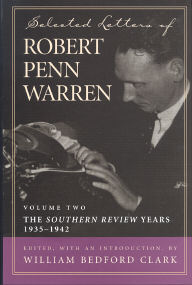
"This second volume of Warren's correspondence highlights his residency at Louisiana State University, teaching and editing the prestigious literary magazine Southern Review. Some of the letters are addressed to Allen Tate, Sherwood Anderson, Katherine Anne Porter, Thomas Wolfe (Warren had reservations about some of Wolfe's work), William Carlos Williams (whose poem was not accepted for publication), and Eudora Welty (the Southern Review was an early champion of her writings)....Serving as backdrop to most of these letters is the rise and fall of the Southern Review. Compiled by Clark, they reveal various sides of Warren: practical and studious (especially along with his associate Cleanth Brooks, in the development of textbooks for teaching poetry and fiction writing), provocative, creative, visionary, loving (revealingly so in his letters to his wife, Cinina), and on occasion, impulsive. Warren's letters reflect the life, full of twists and turns, highs and lows, of a significant literary figure". "Recommended"ŻŻLibrary Journal |
| At
the beginning of 1935, Robert Penn Warren was destined for arguably the most crucial
period in his distinguished career. Having escaped the brink of unemployment the previous
fall to join fellow Vanderbilt alumnus and Rhodes Scholar Cleanth Brooks on the English
faculty at Louisiana State University (which was enjoying a boom thanks to the favoritism
shown by the Long regime), the young author was poised to establish himself, against the
backdrop of the Great Depression and America's belated entry into World War II, as a
compelling new voice, perhaps the most versatile writer of his generation. Continuing where Volume One of the Selected Letters left off, the missives from his Baton Rouge years show Warren exploring and testing the boundaries of his genius on a number of simultaneous fronts. Editing the Southern Review with Brooks was the center of his working life, and it offered him an almost immediate springboard to prominence on both sides of the Atlantic. Warren was determined to establish and maintain the stature of the quarterly even as he systematically nurtured the talent of a younger generation of writers that included Eudora Welty, Randall Jarrell, Peter Taylor, and John Berryman. He attended to his own writing as well and not only emerged as a celebrated poet but also published his first major fiction. During the same period, he and Brooks drew directly upon their classroom challenges to design and launch a series of textbooks that gradually transformed the teaching of poetry in American colleges and universities. What any number of commentators have called Warren's "protean" energy is in full evidence in these letters. The range and sheer diversity of his correspondence, whether with old friends, established literary figures, hopeful young writers, his beloved wife Cinina, recalcitrant academic administrators, or sometimes troublesome publishers, reveal an extraordinary keen mind and heightened imagination operating in concert with optimum efficiency. Scrupulously edited and thoroughly annotated by William Bedford Clark with an eye toward the needs of the lay reader as well as the specialist, Warren's letters have the immediacy of skillful autobiography. A noted authority on Robert Penn Warren, William Bedford Clark has published widely in the field of American literature. He is professor of English at Texas A&M University, the author of The American Vision of Robert Penn Warren, and the editor of Volume One of the Selected Letters of Robert Penn Warren: The Apprentice Years, 1924-1934. |